

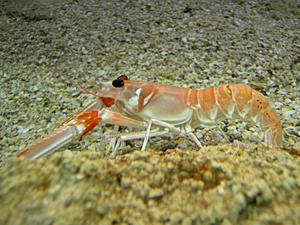
(Da: it.wikipedia.org)
Phylum: Arthropoda Lar, 1904
Subphylum: CrustaceaBrünnich, 1772
Classe: Malacostraca Latreille, 1802
Ordine: Decapoda Latreille, 1802
Famiglia: Nephropidae Dana, 1852
Genere: Nephrops Leach, 1814
Italiano: Scampo
English: Norway lobster
Français: Langoustine commune
Deutsch: Kaisergranat
Español: Cigala
Descrizione
Ha corpo e addome allungati e stretti , meno robusti rispetto al resto delle specie della famiglia. Può raggiungere i 18 centimetri di lunghezza. È di colore rosato. Il primo paio di zampe toraciche è lungo, con artigli lunghi e leggermente diseguali . Anche il secondo e il terzo paio presentano artigli. Il segmento addominale termina a punta su ciascun lato. Gli occhi hanno una cornea nera, molto gonfia, a forma di rene. Il rostro presenta due creste longitudinali; altre creste si trovano sul carapace e sugli artigli. Emergono solo al tramonto e all'alba per nutrirsi. Possono vivere fino a 800 m di profondità. Prediligono fondali morbidi e sabbiosi, dove solitamente si nascondono in gallerie (tane) scavate da loro stessi, a volte lunghe e con più di una via di fuga. Nel Mediterraneo occidentale, la stagione riproduttiva va da luglio a febbraio. Le uova, inizialmente verdi, diventano rosse e spesso si vedono attaccate alla parte inferiore del corpo della femmina, che le ossigena con i movimenti delle sue zampe. Dopo la nascita, i piccoli impiegano circa due anni per raggiungere l'età adulta. Il gambero è un predatore solitario , solitamente nascosto, in quanto sedentario e notturno. Esce poi per nutrirsi, principalmente di vermi policheti e pesci morti, e non disdegna un morso a molluschi, echinodermi e altri crostacei. In breve, è detritivoro e opportunista, quindi si nutre generalmente di ciò che trova nell'ambiente in cui vive, e di una vasta gamma di invertebrati bentonici.
Diffusione
Il suo habitat di riferimento è la parte nord-est dell'oceano Atlantico, nonché parte del mar Mediterraneo, risultando invece assente nel mar Baltico e nel mar Nero. Gli esemplari adulti emergono dalle loro tane durante la notte per alimentarsi di vermi e pesci. Vive soprattutto nelle zone con fondali fangosi
Sinonimi
= Astacus norvegicus = Astacus rugosus = Cancer norvegicus = Homarus norvegicus = Nephropsis cornubiensis = Nephrops norvegicus meridionalis.
Bibliografia
–Lipke B. Holthuis: Marine Lobsters of the World. An Annotated and Illustrated Catalogue of Species of Interest to Fisheries Known to Date. Hrsg.: Food and Agriculture Organization (= FAO Fisheries Synopsis. Band 125). Rom 1991.
–Josef Schormüller> Handbuch der Lebensmittelchemie: Tierische Lebensmittel. Band 3, Teil 2, Springer-Verlag, 1968, S. 1557.
–Mike C. Bell, Frank Redant, Ian Tuck: Nephrops Species. In: Bruce F. Phillips (Hrsg.): Lobsters: Biology, Management, Aquaculture and Fisheries. Wiley-Blackwell, Oxford, UK / Ames, Iowa 2006.
–Marisa Sabatini, Jacqueline Hill: Norway lobster – Nephrops norvegicus – General information. Marine Life Information Network [MarLIN], 2008, abgerufen am 25. Juni 2019 (englisch).
–Lipke B. Holthuis: The lobsters of the Superfamily Nephropidea of the Atlantic Ocean (Crustacea: Decapoda). In: Bulletin of Marine Science. Band 24, Nr. 4, 1974, S. 820.
–Lipke B. Holthuis: The lobsters of the Superfamily Nephropidea of the Atlantic Ocean (Crustacea: Decapoda). In: Bulletin of Marine Science. Band 24, Nr. 4, 1974, S. 821.
–Lipke B. Holthuis: The lobsters of the Superfamily Nephropidea of the Atlantic Ocean (Crustacea: Decapoda). In: Bulletin of Marine Science. Band 24, Nr. 4, 1974, S. 822.
–Nephrops norvegicus. In: Zooplankton and Micronekton of the North Sea. Marine Species Identification Portal, abgerufen am 26. Juli 2012.
–Mike C. Bell, Frank Redant, Ian Tuck: Nephrops Species. In: Bruce F. Phillips (Hrsg.): Lobsters: Biology, Management, Aquaculture and Fisheries. Wiley-Blackwell, Oxford, UK / Ames, Iowa 2006.
–Nephrops norvegicus in der Roten Liste gefährdeter Arten der IUCN 2012. Eingestellt von: Bell, C, 2011.
–Mike C. Bell, Frank Redant, Ian Tuck: Nephrops Species. In: Bruce F. Phillips (Hrsg.): Lobsters: Biology, Management, Aquaculture and Fisheries. Wiley-Blackwell, Oxford, UK / Ames, Iowa 2006.
–Mike C. Bell, Frank Redant, Ian Tuck: Nephrops Species. In: Bruce F. Phillips (Hrsg.): Lobsters: Biology, Management, Aquaculture and Fisheries. Wiley-Blackwell, Oxford, UK / Ames, Iowa 2006.
–F. G. Howard: The Norway Lobster. In: Department of Agriculture and Fisheries for Scotland (Hrsg.): Scottish Fisheries Information Pamphlet. Band 7, 1989, S. 3.
–F. G. Howard: The Norway Lobster. In: Department of Agriculture and Fisheries for Scotland (Hrsg.): Scottish Fisheries Information Pamphlet. Band 7, 1989, S. 6.
–Mike C. Bell, Frank Redant, Ian Tuck: Nephrops Species. In: Bruce F. Phillips (Hrsg.): Lobsters: Biology, Management, Aquaculture and Fisheries. Wiley-Blackwell, Oxford, UK / Ames, Iowa 2006.
–Mike C. Bell, Frank Redant, Ian Tuck: Nephrops Species. In: Bruce F. Phillips (Hrsg.): Lobsters: Biology, Management, Aquaculture and Fisheries. Wiley-Blackwell, Oxford, UK / Ames, Iowa 2006.
–Mike C. Bell, Frank Redant, Ian Tuck: Nephrops Species. In: Bruce F. Phillips (Hrsg.): Lobsters: Biology, Management, Aquaculture and Fisheries. Wiley-Blackwell, Oxford, UK / Ames, Iowa 2006.
–Mario Mori, Milena Modena, Franco Biagi: Fecundity and egg volume in Norway lobster (Nephrops norvegicus) from different depths in the northern Tyrrhenian Sea. In: Scientia Marina. Band 65, Nr. 2, 2001, S. 111–116.
–Mike C. Bell, Frank Redant, Ian Tuck: Nephrops Species. In: Bruce F. Phillips (Hrsg.): Lobsters: Biology, Management, Aquaculture and Fisheries. Wiley-Blackwell, Oxford, UK / Ames, Iowa 2006.
–Mike C. Bell, Frank Redant, Ian Tuck: Nephrops Species. In: Bruce F. Phillips (Hrsg.): Lobsters: Biology, Management, Aquaculture and Fisheries. Wiley-Blackwell, Oxford, UK / Ames, Iowa 2006.
–Mike C. Bell, Frank Redant, Ian Tuck: Nephrops Species. In: Bruce F. Phillips (Hrsg.): Lobsters: Biology, Management, Aquaculture and Fisheries. Wiley-Blackwell, Oxford, UK / Ames, Iowa 2006.
–Mike C. Bell, Frank Redant, Ian Tuck: Nephrops Species. In: Bruce F. Phillips (Hrsg.): Lobsters: Biology, Management, Aquaculture and Fisheries. Wiley-Blackwell, Oxford, UK / Ames, Iowa 2006.
–F. G. Howard: The Norway Lobster. In: Department of Agriculture and Fisheries for Scotland (Hrsg.): Scottish Fisheries Information Pamphlet. Band 7, 1989, S. 7.
–Marisa Sabatini, Jacqueline Hill: Norway lobster – Nephrops norvegicus – Reproduction and longevity. Marine Life Information Network [MarLIN], 2008, abgerufen am 25. Juni 2019 (englisch).
–Marisa Sabatini, Jacqueline Hill: Norway lobster – Nephrops norvegicus – General biology. Marine Life Information Network [MarLIN], 2008.
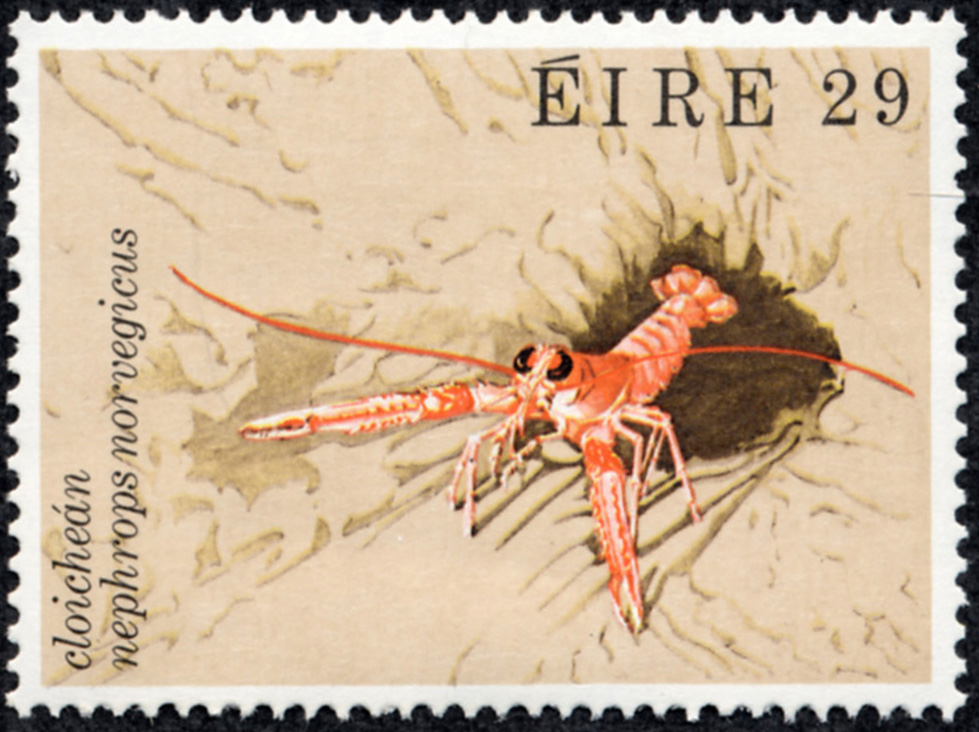
|
Data: 29/07/1982
Emissione: Vita nel mare Stato: Ireland Nota: Emesso in una serie di 4 v. diversi |
|---|
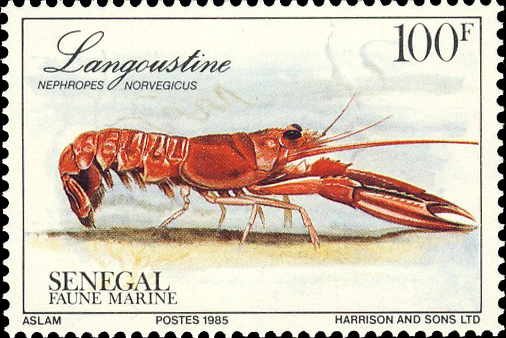
|
Stato: Senegal |
|---|
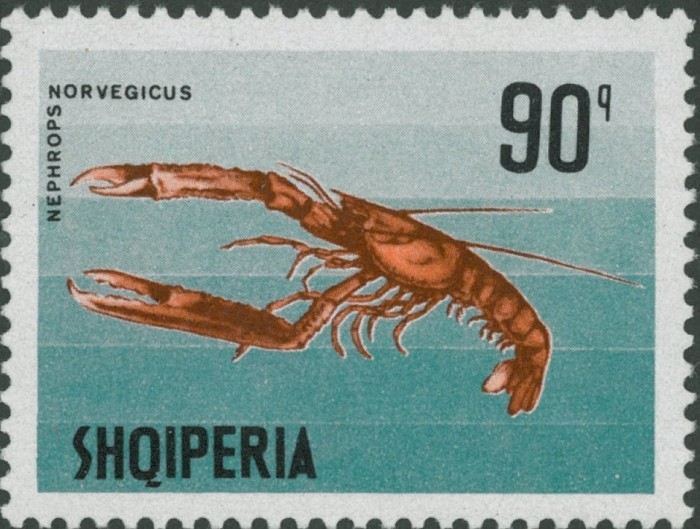
|
Data: 20/08/1968
Emissione: Vita marina Stato: Albania Nota: Emesso in una serie di 7 v. diversi |
|---|
|
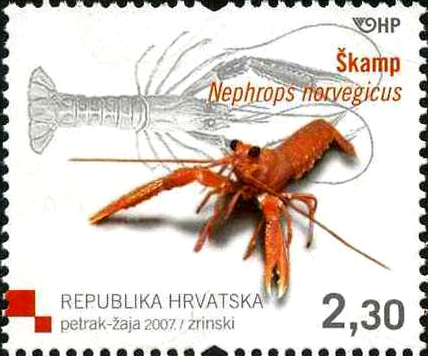
Data: 15/03/2007
Emissione: Fauna croata (X) Granchi Stato: Croatia |
|---|
|
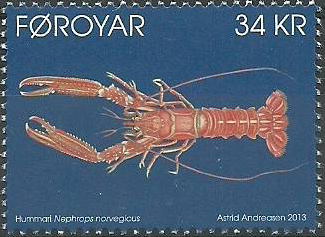
Data: 25/02/2013
Emissione: Alimenti dal mare - Crostacei Stato: Faroe Islands |
|---|

|
Data: 02/01/2017
Emissione: Fauna marina Stato: Denmark Nota: Emesso in una serie di 5 v. diversi |
|---|

|
Data: 01/10/1996
Emissione: Crostacei Stato: Great Socialist People's Libyan Arab Jamahiriya Nota: Emesso in un foglietto di 16 v. diversi |
|---|

|
Data: 01/01/2019
Emissione: I crostacei Stato: Togo |
|---|